Key takeaways
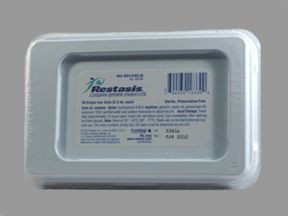
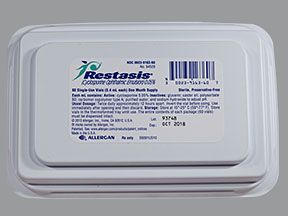
- Restasis is a prescription eye drop that’s used to treat chronic (long-term) dry eye in adults and some children. It’s the brand-name version of the generic drug cyclosporine.
- Cyclosporine belongs to a group of immunosuppressant drugs called calcineurin inhibitors. Immunosuppressant drugs work to decrease the activity of the immune system.
- Restasis comes in two forms: Restasis and Restasis MultiDose. The dosage for either drug is one drop in each eye, twice per day (12 hours apart).
Keep reading to learn more about Restasis, including its dosage, side effects, price, and more.
Optum Now is operated by RVO Health. By clicking on this link, we may receive a commission. Learn more.
Your doctor will recommend the dosage of Restasis that’s right for you. This section discusses commonly prescribed dosages, but always use the dosage your doctor prescribes.
Form and strength
Restasis comes as an emulsion (an oily, liquid mixture) that you use as an eye drop. It comes in one strength: 0.5 milligrams per milliliter of solution (mg/mL). This strength can also be written as 0.05%.
Recommended dosage
For treating chronic dry eye, you’ll apply one Restasis drop to each eye twice per day. These doses should be applied about 12 hours apart. But be sure to follow your doctor’s dosing instructions.
Questions about Restasis’s dosage
Here are some common questions about Restasis and dosage.
- What if I miss a dose of Restasis? If you miss a Restasis dose, take the missed dose as soon as you remember. But if it’s almost time for your next dose, skip the dose you’ve missed. Then apply your next dose of eye drops at the scheduled time. Do not use more than one Restasis drop in each eye for each dose.
- Will I need to use Restasis long term? You’ll likely use Restasis long term if you and your doctor agree that it’s safe and working well for you.
- How many drops of Restasis do I use in each eye? You’ll use one drop of Restasis in each eye, likely twice per day. But always use the dose your doctor prescribes for you.
- How long does it take Restasis to work? Restasis may take 4 to 6 months to relieve symptoms of dry eye. But some people have symptom relief in about a month.
Restasis and Restasis MultiDose are basically the same medication. They’re both prescribed to treat chronic dry eye in adults and some older children. Both contain cyclosporine as the active ingredient. (This is the ingredient that makes a drug work.)
The only difference is that Restasis comes in single-use vials, while Restasis MultiDose comes in a bottle containing multiple doses.
To find out more about how Restasis and Restasis MultiDose compare, talk with your doctor.
Like most drugs, Restasis may cause mild to serious side effects.
Here’s a list of some of the mild side effects Restasis can cause. To learn about other mild side effects, talk with your doctor or pharmacist, or read the drug’s prescribing information.
Mild side effects of Restasis that have been reported include:
- feeling as if something is in your eye
- blurry vision
- eye pain
- watery eyes
- burning sensation in the eye
- itchy eye
- red eye
Mild side effects of many drugs may go away within a few days to a couple of weeks. But if they become bothersome, talk with your doctor or pharmacist.
Serious side effects
Serious side effects from Restasis can occur, but they aren’t common. If you have serious side effects from Restasis, call your doctor right away. But if you think you’re having a medical emergency, call 911 or your local emergency number.
Restasis may cause an allergic reaction. Note that this side effect wasn’t reported in studies of Restasis. But there were reports of people experiencing this side effect since the drug was approved for use.
Allergic reactionSome people may have an allergic reaction to Restasis. This side effect wasn’t reported in studies of Restasis but has occurred since the drug was approved for use.
Symptoms of a mild allergic reaction can include:
A more severe allergic reaction is rare but possible. Symptoms of a severe allergic reaction can include swelling under your skin, usually in your eyelids, lips, hands, or feet. They can also include swelling of your tongue, mouth, or throat, which can cause difficulty breathing.
Call your doctor right away if you have an allergic reaction to Restasis. But if you think you’re having a medical emergency, call 911 or your local emergency number.
Find answers to some commonly asked questions about Restasis.
Yes, there are alternatives for Restasis, including homeopathic alternatives.
“Homeopathic” refers to homeopathy, a treatment philosophy developed more than 200 years ago. It’s based in part on the “law of minimum dose.” This is the belief that medications are more effective at lower doses.
Homeopathic treatments are often made of low doses of plant, animal, or mineral products. An example of a homeopathic treatment for chronic dry eye is the herb eyebright (Euphrasia). But there is little to no evidence supporting the use of homeopathy for treating any medical condition, including chronic dry eye.
Homeopathy should not be used to replace conventional treatments shown to work. It should also not be used as a reason to postpone or avoid contacting a healthcare professional about a medical concern.
Other alternatives that are effective for managing chronic dry eye include:
- cyclosporine 0.09% (Cequa)
- dextran/hypromellose (Bion Tears)
- lifitegrast (Xiidra)
- loteprednol etabonate (Lotemax, others)
- polyethylene glycol/propylene glycol (Systane)
Some of these alternatives are available over the counter (OTC). But before you try any OTC treatments, ask your doctor whether it’s safe for you to do so.
Other treatments for chronic dry eye include:
- punctal plugs (tiny tubes placed into your tear ducts that help tears stay in your eyes)
- cleansing your eye area with diluted baby shampoo
Talk with your doctor or pharmacist if you’d like to learn more about alternatives for Restasis.
No, withdrawal symptoms aren’t likely if you stop using Restasis. (Withdrawal symptoms are symptoms that happen as a result of stopping a medication.)
But if you stop using Restasis, your dry eye symptoms may return. This may be prevented by using a different treatment for chronic dry eye.
For this reason, you should talk with your doctor if you’re interested in stopping Restasis treatment. They can discuss other treatment options with you.
Restasis isn’t approved to treat blepharitis (eyelid inflammation), but it may be used off-label for this condition. (With off-label use, a drug is prescribed for a condition it isn’t approved to treat.)
Blepharitis causes symptoms including:
- itchy or swollen eyelids
- a burning sensation in your eye
- sensitivity to light
If you’re interested in learning more about off-label uses of Restasis, such as for blepharitis, talk with your doctor or pharmacist.
Your doctor will explain how you should use Restasis. They’ll also explain how much to use and how often. Be sure to follow your doctor’s instructions.
Using Restasis
Restasis comes as an emulsion (an oily, liquid mixture) that is administered as an eye drop.
If you wear contact lenses, remove them before putting Restasis in your eyes. And wait at least 15 minutes before putting your contact lenses back in after giving yourself a dose.
If you need tips for applying eye drops, check out this article on how to use eyedrops.
Using Restasis with other drugs
Depending on your dry eye symptoms, your doctor may prescribe Restasis alone or for use with other drugs.
Using other eye drops with Restasis
Your doctor may suggest using other eye drops along with Restasis. If you’d like to know more, talk with your doctor. They can recommend whether you’ll need other eye drops and how they should be used together with Restasis.
In studies, some people used Restasis along with other anti-inflammatory eye drops. It’s important to note that these people did not see an increase in tear production while using Restasis. For this reason, your doctor may recommend that you avoid anti-inflammatory eye drops while using Restasis. Examples include:
- loteprednol (Alrex, Eysuvis, Lotemax, others)
- dexamethasone (Maxidex)
Questions for your doctorYou may have questions about Restasis and your treatment plan. It’s important to discuss all your concerns with your doctor.
Here are a few tips that might help guide your discussion:
- Before your appointment, write down questions such as:
- How will Restasis affect me?
- Bring someone with you to your appointment if doing so will help you feel more comfortable.
- If you don’t understand something related to your condition or treatment, ask your doctor to explain it to you.
Remember, your doctor and other healthcare professionals are available to help you. And they want you to get the best care possible. So don’t be afraid to ask questions or offer feedback on your treatment.
There are important things you should discuss with your doctor before starting treatment with Restasis. It’s important to tell them about your overall health, any medical conditions you may have, and any medications you take.
Interactions
Taking a medication with certain vaccines, foods, and other things can affect how the medication works. These effects are called interactions.
Restasis isn’t known to interact with other medications. But you should still tell your doctor about all medications you take, including prescription and over-the-counter kinds, before you start Restasis. You should also describe any vitamins, herbs, or supplements you use. Your doctor or pharmacist can use this information to monitor for any new drug interactions that may be discovered while you’re using Restasis.
Warnings
Restasis may not be right for you if you have certain medical conditions or other factors that affect your health. (Conditions or factors that could prevent your doctor from prescribing a drug are known as contraindications.) Talk with your doctor about your health history before you use Restasis. Factors to consider include:
Contact lenses: Wearing contact lenses usually isn’t recommended if you have chronic dry eye. Contacts need moisture to function correctly and may not work well in people with dry eye. If you do wear contacts, it’s important to take them out before putting Restasis drops in your eyes. And you’ll need to wait at least 15 minutes after applying the drops before putting contact lenses in.
Allergic reaction: If you’ve had an allergic reaction to Restasis or any of its ingredients, your doctor will likely not prescribe it for you. Ask them what other medications might be better options.
Restasis and alcohol
Alcohol isn’t known to interact with Restasis eye drop treatment. If you have questions about consuming alcohol while using Restasis, talk with your doctor.
Pregnancy and breastfeeding
It should be safe to use Restasis during pregnancy. Because Restasis is an eye drop, your body doesn’t absorb the medication. It’s only expected to affect your eyes. Your doctor can discuss the safety of using Restasis during pregnancy with you.
It’s not known whether it’s safe to breastfeed while using Restasis. But because the drug is not expected to be absorbed by the rest of your body, it’s unlikely that it would cause side effects in a child who is breastfed.
If you’re breastfeeding or planning to breastfeed, talk with your doctor before using Restasis.
Whether you have health insurance or not, cost may be a factor when you’re considering X drug. What you’ll pay for X drug may depend on several things, such as your treatment plan and the pharmacy you use.
Here are a few things to consider regarding cost:
- Comparing pharmacies: The price of Restasis may vary depending on which pharmacy you use, so it can help to compare prices across pharmacies to find the lowest cost.
- Generic form: Restasis is available as the generic drug cyclosporine. Generics usually cost less than brand-name drugs. Talk with your doctor if you’d like to know whether generic cyclosporine could be an option for you.
- Savings program: A program called the Restasis Savings Program may be available. For more information and to find out whether you’re eligible for support, call 844-469-8327 or visit the program website.
If you have questions about how to pay for your prescription, talk with your doctor or pharmacist.
You may wonder how Restasis compares with other drugs for chronic dry eye, such as Xiidra. To learn how these drugs are alike and different, check out this comparison of Xiidra with Restasis.
Your doctor can also tell you more about these treatment options.
Q:
Will using Restasis cause weird tastes in my mouth?
AnonymousA:
No, it’s not likely. Weird tastes weren’t a side effect reported by people who used Restasis in studies.
Having a weird or changed sense of taste is known as dysgeusia. This is a side effect of Xiidra, a different drug prescribed to treat chronic dry eye. But this isn’t a known side effect of Restasis.
The Healthline Pharmacist TeamAnswers represent the opinions of our medical experts. All content is strictly informational and should not be considered medical advice.Disclaimer: Healthline has made every effort to make certain that all information is factually correct, comprehensive, and up to date. However, this article should not be used as a substitute for the knowledge and expertise of a licensed healthcare professional. You should always consult your doctor or another healthcare professional before taking any medication. The drug information contained herein is subject to change and is not intended to cover all possible uses, directions, precautions, warnings, drug interactions, allergic reactions, or adverse effects. The absence of warnings or other information for a given drug does not indicate that the drug or drug combination is safe, effective, or appropriate for all patients or all specific uses.